Interest Calculator
Calculate simple & compound interest with beautiful visualizations
Input Parameters
Results
Total Amount
$16,288.95
Principal + Interest
Interest Calculator: From Simple Math to Financial Mastery
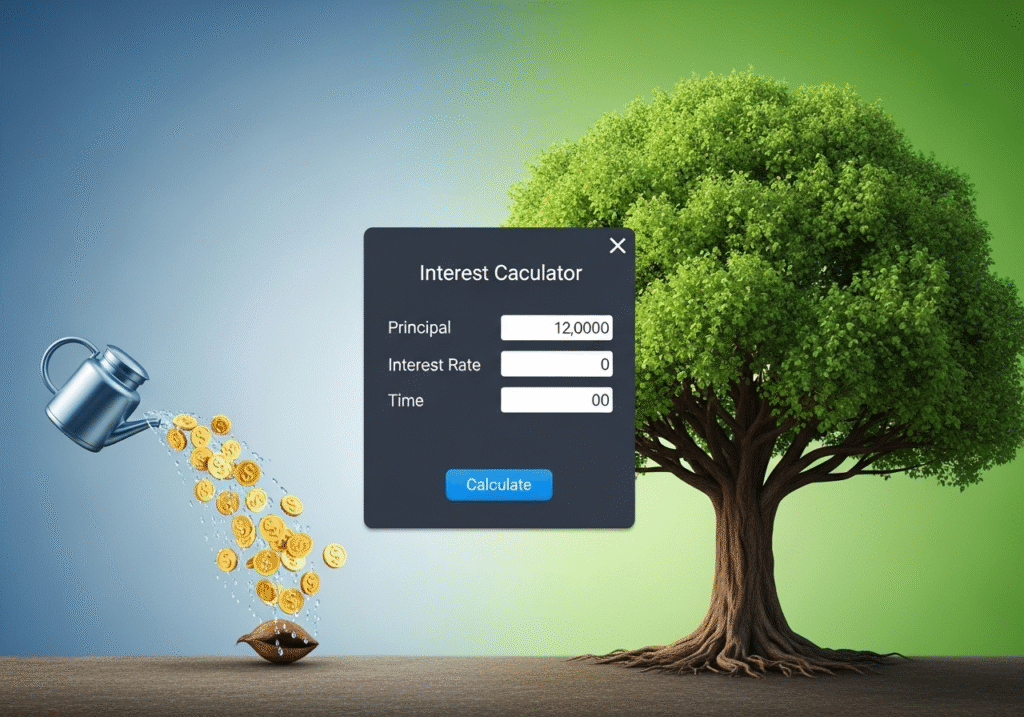
There is an invisible force shaping your financial life.
It works silently, 24 hours a day, 7 days a week. When it works for you, it can build fortunes from scratch, transforming small, consistent efforts into staggering wealth. When it works against you, it can be a relentless tide, dragging you deeper into a sea of debt, making escape feel impossible.
This force is interest.
For most of us, interest is an abstract concept. It’s a tiny percentage on our savings account statement or a confusing number buried in the fine print of a loan agreement. We know it exists, but we rarely feel its true, earth-shattering power. Why? Because we can’t see it. We can’t visualize its impact over five, ten, or thirty years.
Until now.
The tool that makes this invisible force visible is the Interest Calculator. It is, without exaggeration, one of the most powerful financial instruments you can wield, and it’s available to you for free. It’s a crystal ball that lets you peer into your financial future. It’s a magnifying glass that reveals the true cost of debt. It’s a blueprint that allows you to design the financial life you want.
This is not just a guide on how to use a calculator. This is your masterclass in understanding the engine of finance. We will go far beyond plugging in numbers. We will decode the very DNA of how money grows and how debt accumulates.
By the time you finish this guide, you will be able to:
- Grasp the profound difference between your greatest financial ally (compound interest) and your greatest enemy (high-APR debt).
- Confidently calculate and compare savings accounts, investments, and CDs.
- Uncover the shocking, hidden cost of loans and credit cards.
- Use a calculator to craft a strategic plan for saving, investing, and eliminating debt.
- Transform financial anxiety and uncertainty into clarity and control.
Prepare to harness the most powerful force in finance. Let’s make the invisible, visible.
Table of Contents
- Chapter 1: The Two Faces of Interest – Your Greatest Ally or Fiercest Enemy
- What is Interest? The Simple “Rent” Analogy
- Interest You Earn vs. Interest You Pay
- Chapter 2: The Foundation – Decoding Simple Interest
- The Formula Made Easy: P x R x T
- A Real-World Example: The Certificate of Deposit (CD)
- When is Simple Interest Used?
- Using a Simple Interest Calculator
- Chapter 3: The Eighth Wonder of the World – Mastering Compound Interest
- The “Snowball Effect”: How Your Money Makes Money
- Simple vs. Compound: A Decade-Long Battle for Your Dollars
- The Four Levers of Wealth: Inside the Compound Interest Calculator
- The Superpower of Compounding Frequency (Annual vs. Monthly vs. Daily)
- The Parable of the Two Savers: Why Starting Early is Everything
- Chapter 4: The Other Side of the Coin – Demystifying Loan Interest
- Introducing Amortization: The Grand Unveiling of Your Payments
- The Seesaw of Debt: How Payments Shift from Interest to Principal
- Using an Amortization Calculator to See the True Cost of a Loan
- Chapter 5: The Borrower’s Nightmare – Dissecting Credit Card Interest (APR)
- Why Credit Card Debt is a Different Beast
- The Sneaky Danger of Daily Compounding
- The Minimum Payment Trap: A Shocking Case Study
- From Trap to Triumph: Using a Calculator to Build Your Escape Plan
- Chapter 6: Practical Magic – Everyday Scenarios for Your Interest Calculator
- Scenario 1: Comparing Two Savings Accounts
- Scenario 2: Planning Your Retirement Nest Egg
- Scenario 3: Setting a Goal to Save $20,000 for a Down Payment
- Scenario 4: Visualizing Your Debt Snowball Payoff
- Conclusion: From Abstract Concept to Concrete Control
Chapter 1: The Two Faces of Interest – Your Greatest Ally or Fiercest Enemy
Before we can calculate it, we must understand its dual nature. Interest is fundamentally neutral, like fire. It can cook your food and warm your home, or it can burn your house down. It all depends on which side of the flame you are on.
What is Interest? The Simple “Rent” Analogy
The easiest way to understand interest is to think of money as a property that can be rented.
- When you deposit money into a savings account, you are letting the bank rent your money. They use it to give out loans to other people. In return for using your money, they pay you a rental fee. That fee is interest.
- When you take out a loan (for a car, a house, or on a credit card), you are renting the bank’s money. You get to use their money now, but you have to pay them a rental fee for the privilege. That fee is also interest.
It’s that simple. Interest is the cost of using someone else’s money, whether they are using yours or you are using theirs. An interest calculator is simply a tool to figure out the exact price of that rental over time.
Interest You Earn vs. Interest You Pay
This is the fundamental divide that determines your financial trajectory.
Interest You Earn (Your Ally): This is the interest you receive from savings accounts, certificates of deposit (CDs), bonds, and other investments. This is the “good” interest, the one that works for you while you sleep. The goal is to maximize this.
Interest You Pay (Your Enemy): This is the interest you are charged on mortgages, auto loans, student loans, personal loans, and credit card debt. This is the “bad” interest, the one that works against you every second of the day. The goal is to minimize this.
A person building wealth is one whose “ally” interest is growing faster than their “enemy” interest is accumulating. The rest of this guide is dedicated to showing you how to calculate and control both sides of this crucial equation.
Chapter 2: The Foundation – Decoding Simple Interest
We begin with the most basic form of interest calculation. While it’s less common in our daily lives than its more powerful cousin, understanding simple interest is the essential first step.
Simple interest is calculated only on the original amount of money, known as the principal. You don’t earn interest on the interest you’ve already accrued.
The Formula Made Easy: P x R x T
The formula looks like something from a high school math test, but it’s incredibly straightforward.
Interest = Principal x Rate x Time
- P (Principal): The initial amount of money.
- R (Rate): The interest rate, expressed as a decimal for the calculation. (e.g., 5% becomes 0.05).
- T (Time): The number of time periods (usually years).
A Real-World Example: The Certificate of Deposit (CD)
Let’s say you want to put $10,000 (Principal) into a 5-year CD that pays a 3% annual simple interest rate (Rate).
- P = $10,000
- R = 0.03
- T = 5 years
Calculation:
Interest = $10,000 x 0.03 x 5
Interest = $300 x 5
Interest = $1,500
After 5 years, you would have earned $1,500 in interest. Your total amount would be your original principal plus the interest: $10,000 +
1,500=∗∗1,500 = **1,500=∗∗
11,500**.
Notice that you earned exactly $300 each year. The earnings never grew, because the interest was always calculated on the original $10,000.
When is Simple Interest Used?
Simple interest is most common in shorter-term financial products. You might encounter it with:
- Some certificates of deposit (CDs).
- Short-term personal loans or “payday” loans.
- Auto loans (where the interest is front-loaded in an amortization schedule, but the underlying concept is similar to a simple interest calculation per payment).
Using a Simple Interest Calculator
An online simple interest calculator does the P x R x T math for you instantly. You simply input the principal, the annual rate, and the duration, and it will spit out your total interest earned and the final value of your investment. It’s a useful tool for a quick comparison of simple-yield products.
But now, let’s meet the superstar of the interest world.
Chapter 3: The Eighth Wonder of the World – Mastering Compound Interest
Albert Einstein is often quoted as saying, “Compound interest is the eighth wonder of the world. He who understands it, earns it; he who doesn’t, pays it.”
He wasn’t exaggerating.
Compound interest is interest calculated on the initial principal and also on the accumulated interest from previous periods. In other words, you start earning “interest on your interest.”
The “Snowball Effect”: How Your Money Makes Money
This is the perfect analogy. Imagine you start with a small snowball (your principal) at the top of a very long, snowy hill.
- With simple interest, you just push that small snowball to the bottom. It arrives the same size it started.
- With compound interest, you give it a gentle push and let it roll. As it rolls, it picks up more snow (your interest payments). The bigger the snowball gets, the more snow it picks up with each rotation. By the time it reaches the bottom of the hill, it’s a massive, unstoppable boulder.
That is the magic of compounding. Your money doesn’t just grow; the rate of its growth accelerates over time.
Simple vs. Compound: A Decade-Long Battle for Your Dollars
Let’s revisit our $10,000 investment at a 3% annual rate, but this time, let’s see what happens if the interest compounds annually.
[Table: A clear, year-by-year comparison table showing the growth of $10,000 at 3% simple interest vs. 3% compound interest over 10 years.]
| Year | Simple Interest Total | Compound Interest Total | The Difference |
| Start | $10,000.00 | $10,000.00 | $0.00 |
| 1 | $10,300.00 | $10,300.00 | $0.00 |
| 2 | $10,600.00 | $10,609.00 | $9.00 |
| 3 | $10,900.00 | $10,927.27 | $27.27 |
| … | … | … | … |
| 5 | $11,500.00 | $11,592.74 | $92.74 |
| … | … | … | … |
| 10 | $13,000.00 | $13,439.16 | $439.16 |
| 30 | $19,000.00 | $24,272.62 | $5,272.62 |
| 50 | $25,000.00 | $43,839.06 | $18,839.06 |
As you can see, the difference starts small. After a year, it’s nothing. After two years, it’s just $9. But over time, the gap widens into a chasm. The compound interest snowball is picking up speed. After 50 years, the “free money” earned from compounding is more than the original investment itself!
The Four Levers of Wealth: Inside the Compound Interest Calculator
A compound interest calculator has a few key inputs. These are the levers you can pull to change your financial future.
- Initial Principal: The starting amount. The bigger your initial snowball, the better.
- Contributions: This is a crucial addition. It’s the new money you add to the pile regularly (e.g., $100 per month). This is like constantly adding more snow to your rolling snowball.
- Interest Rate: The rate of return. A higher rate dramatically accelerates growth.
- Time (The Magic Ingredient): This is the most powerful lever of all. Time is the length of the hill your snowball rolls down. The longer the time, the more dramatic the compounding effect.
The Superpower of Compounding Frequency
How often is your interest calculated and added to the principal? This is the compounding frequency.
- Annually: Once per year.
- Semi-Annually: Twice per year.
- Quarterly: Four times per year.
- Monthly: 12 times per year.
- Daily: 365 times per year.
The more frequently interest compounds, the faster your money grows. The difference isn’t always huge over short periods, but over decades, it adds up. Daily compounding will always result in more money than annual compounding at the same interest rate. Most high-yield savings accounts today compound daily.
The Parable of the Two Savers: Why Starting Early is Everything
Let’s use a compound interest calculator to illustrate its most important lesson.
[Infographic: A side-by-side comparison of “Early Bird Emily” and “Late Starter Larry,” showing their investment timelines and final amounts.]
- Early Bird Emily: Starts investing at age 25. She puts $200 per month into an investment account earning an average of 8% per year. She does this for just 10 years and then stops completely at age 35. Her total contribution is
200x12monthsx10years=∗∗200 x 12 months x 10 years = **200x12monthsx10years=∗∗24,000**. She then lets the money sit and compound until age 65. - Late Starter Larry: He waits until he’s 35 to start. He also invests $200 per month at 8% per year. But to catch up, he invests consistently for 30 years, all the way until age 65. His total contribution is
200x12monthsx30years=∗∗200 x 12 months x 30 years = **200x12monthsx30years=∗∗72,000**.
Who has more money at age 65?
Let’s run the numbers:
- Early Bird Emily’s Result: Despite only investing
24,000,atage65heraccounthasgrowntoapproximately∗∗24,000, at age 65 her account has grown to approximately **24,000,atage65heraccounthasgrowntoapproximately∗∗314,870**. - Late Starter Larry’s Result: Despite investing three times as much money (
72,000),atage65hisaccounthasgrowntoapproximately∗∗72,000), at age 65 his account has grown to approximately **72,000),atage65hisaccounthasgrowntoapproximately∗∗298,240**.
Emily, who let the magic of compounding work for 40 years, ended up with more money by investing far less. Time is the most critical ingredient in the recipe for wealth. An interest calculator proves this with brutal clarity.
Chapter 4: The Other Side of the Coin – Demystifying Loan Interest
Now we must turn the fire around. The same compounding principles that build wealth can be devastating when applied to debt. When you take out a loan, you are on the wrong side of the equation.
Introducing Amortization: The Grand Unveiling of Your Payments
For most installment loans (mortgage, auto, personal), your payment is fixed every month. But what’s happening inside that payment changes dramatically over time. This process is called amortization.
An amortization calculator, a specialized type of interest calculator, breaks down each payment for you, showing you how much is going to interest and how much is going to reduce your principal.
The Seesaw of Debt: How Payments Shift from Interest to Principal
Think of your monthly payment as sitting on a seesaw.
- At the beginning of the loan, your principal balance is huge. The “interest” side of the seesaw is heavy, so most of your payment goes toward paying the interest fee. The “principal” side is light, so only a small portion chips away at your actual debt.
- As you make payments, your principal balance slowly shrinks. The “interest” side of the seesaw gets lighter, and the “principal” side gets heavier. More and more of your payment goes toward destroying the debt.
- By the end of the loan, the seesaw has completely tipped. Your final payments are almost all principal, with only a tiny sliver going to interest.
Using an Amortization Calculator to See the True Cost of a Loan
Let’s take a common example: a $25,000 auto loan with a 5-year (60-month) term and a 6% interest rate.
A payment calculator will tell you the monthly payment is $483.32.
But an amortization calculator reveals the full story:
- Your very first payment of $483.32:
- $125.00 goes to interest.
- $358.32 goes to principal.
- Your very last payment of $483.32:
- $2.40 goes to interest.
- $480.92 goes to principal.
Most importantly, the calculator shows you the Total Interest Paid. For this loan, you would pay a total of $3,999.38 in interest. The “true cost” of your $25,000 car was almost $29,000. This number, revealed by the calculator, is essential for making an informed borrowing decision.
Chapter 5: The Borrower’s Nightmare – Dissecting Credit Card Interest (APR)
If installment loans are a seesaw, credit card debt is a whirlpool. It’s a different kind of debt—”revolving debt”—and the interest works in a much more punishing way.
Why Credit Card Debt is a Different Beast
- High Interest Rates (APR): Credit card Annual Percentage Rates (APRs) are often brutally high, frequently ranging from 15% to 29% or more.
- No Fixed Term: There’s no end date. You can stay in debt forever if you only make minimum payments.
- Daily Compounding: This is the killer. The 20% APR you see is not calculated once a year. It’s broken down into a daily rate, and the interest is often calculated and added to your balance every single day.
The Minimum Payment Trap: A Shocking Case Study
Let’s use a credit card interest calculator to see this trap in action.
- Credit Card Balance: $3,000
- Interest Rate (APR): 21%
- Minimum Payment: 2% of the balance or $25, whichever is greater. (Let’s assume it’s around $60 to start).
If you decide to pay only the minimum payment each month…
- It will take you over 17 years to pay off the debt.
- You will have paid a staggering $4,650 in interest on your original $3,000 balance.
You will have paid the credit card company more in interest than the amount you originally spent. This is how millions of people get stuck in a cycle of debt.
From Trap to Triumph: Using a Calculator to Build Your Escape Plan
A credit card payoff calculator works in reverse. It empowers you to create a plan. You can input your balance and APR and then ask:
- “How much do I need to pay per month to be debt-free in 24 months?”
- The calculator will answer: “You need to pay $154 per month.”
Suddenly, the vague, overwhelming problem has a concrete, actionable solution. The calculator transforms a hopeless situation into a clear mission with a defined finish line.
Chapter 6: Practical Magic – Everyday Scenarios for Your Interest Calculator
An interest calculator is not just a theoretical tool. It’s a practical decision-making machine. Here are a few ways to use it.
- Scenario 1: Comparing Two Savings Accounts
- Bank A: Offers 4.50% APY, compounded daily.
- Bank B: Offers 4.55% APY, compounded monthly.
- You can use the calculator to see which one will actually yield more money on your savings amount over a year.
- Scenario 2: Planning Your Retirement Nest Egg
- Question: “If I save $500 a month starting at age 30, how much will I have at age 67, assuming a 7% average return?”
- The calculator provides the answer: Over $1.1 million. This visualization can be the single greatest motivation to start saving.
- Scenario 3: Setting a Goal to Save $20,000 for a Down Payment
- Question: “I have $5,000 saved now in an account earning 4% interest. How much do I need to save per month to reach $20,000 in 3 years?”
- The calculator will tell you exactly what your monthly savings target needs to be.
- Scenario 4: Visualizing Your Debt Snowball Payoff
- You can use a loan calculator to see how quickly you can pay off a debt by adding the “freed up” payment from a smaller, paid-off debt. It helps you stay motivated by showing you the accelerated progress.
Conclusion: From Abstract Concept to Concrete Control
Interest is the language of money. For most of our lives, we’ve been trying to get by without being fluent, catching only a few words here and there. This leads to confusion, missed opportunities, and costly mistakes.
An interest calculator is your personal translator. It converts the complex, abstract language of finance into the one language that matters: your dollars, your goals, and your timeline.
It reveals the quiet miracle of compounding and the loud danger of debt. It shows you the monumental impact of starting early, the hidden cost in a monthly payment, and the clear path out of a financial hole.
You are no longer in the dark. You now have the flashlight. You can see the force of interest, and by seeing it, you can control it. You can ensure that this powerful, invisible force is pushing you forward, not holding you back.
Stop wondering. Stop guessing. Start calculating. Your future self will thank you for it.
Disclaimer: This article is for informational and educational purposes only. The examples provided are illustrative. The information contained herein is not a substitute for, and should never be relied upon for, professional financial advice. Always consult with a qualified financial advisor regarding your personal financial situation.