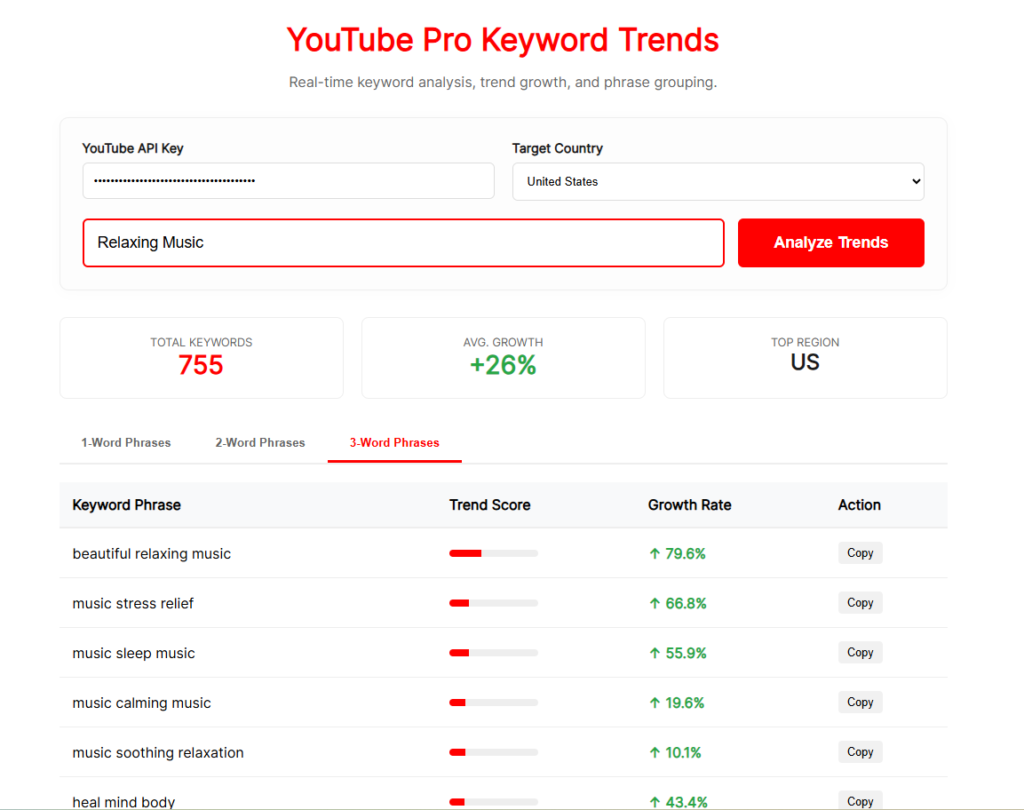
YouTube Pro Keyword Trends
Real-time keyword analysis, trend growth, and phrase grouping.
YouTube Pro Keyword Trends: The digital video landscape has fundamentally changed. The era of uploading a video with a generic title, copy-pasting standard tags, and crossing your fingers for millions of views is officially over. Today, data-driven content creation rules the platform.
With over 200 billion daily views on YouTube Shorts and search engines directly integrating video content into conversational AI Overviews, traditional search engine optimization (SEO) has evolved into a high-stakes science.
To build a sustainable channel that captures massive traffic, you need to understand YouTube Pro Keyword Trends. This comprehensive guide will dissect how the current search algorithm functions, uncover the mechanics of high-yield keyword research, and provide a framework to dominate video search rankings.
1. The Architecture of the Modern Search Algorithm
To successfully capitalize on keyword trends, you must understand what the algorithm actually measures. The system has evolved from simple text matching to deep semantic understanding and behavioral tracking.
Historically, the search engine looked for an exact match between a user’s typed phrase and the words written in your video title. If a user searched for “how to fix a leaky faucet,” the system looked for that exact string.
Today, the core architecture relies on an advanced feedback loop focused heavily on search satisfaction.
User Search Query ➔ Click-Through Rate (CTR) ➔ Average View Duration (AVD) ➔ Search Satisfaction Score
The Search Satisfaction Framework
- Semantic Intent Mapping: The AI naturally understands context, synonyms, and localized phrasing. It processes the concept of your video rather than just your literal text.
- In-Video Audio Parsing: YouTube automatically transcribes your video files in real time. It scans your spoken words for target keywords. If you do not say your primary keyword within the first 60 seconds of your video, your ranking potential drops significantly.
- The Satisfaction Trap: High click-through rates (CTR) are no longer enough. If a viewer clicks your video because of an optimized title but leaves within 30 seconds, your satisfaction score plummets. The algorithm interprets this as a mismatch between keyword intent and content delivery, depressing your visibility in subsequent searches.
2. Deciphering the 4 Golden Keyword Layers
Professional creators avoid throwing random keywords at a wall. Instead, they run an intentional keyword stacking strategy. Successful channels categorize search queries into four distinct buckets, balancing short-term traffic spikes with long-term baseline views.
Layer 1: Seed Keywords (The Foundation)
These are broad, high-competition, one-to-two-word phrases that define your overall niche. Examples include personal finance, Python programming, or gardening. You will rarely rank for these directly if you are a small or growing channel, but they serve as the root system for your deeper research.
Layer 2: Long-Tail Keywords (The Growth Engine)
Long-tail keywords are highly specific phrases, typically consisting of three to five words. While they command lower individual monthly search volumes, they carry incredibly high user intent and minimal competition.
Example: Instead of targeting “camera review” (Seed), a pro creator targets “best mirrorless camera under 500 for YouTube beginners” (Long-Tail). This precise match makes it vastly easier for a new video to claim the top spot.
Layer 3: Question-Based Keywords (The Informational Hub)
These queries begin with how to, why, can I, or what is. These are arguably the most valuable keywords for building topic authority. Furthermore, question-based videos are frequently pulled directly into Google Search results and AI-generated answers, opening up a major external traffic source.
Layer 4: Trending Keywords (The Velocity Spike)
Trending terms are highly time-sensitive queries that experience a massive, sudden surge in search volume due to real-world events, product launches, or pop-culture moments. Targeting terms like Apple Vision Pro 2 review or DaVinci Resolve update changes provides your channel with an immediate injection of views and active subscribers.
3. High-Yield Keyword Research: Step-by-Step
Finding high-performing keywords requires a systematic discovery process. This tactical blueprint bypasses guesswork to uncover high-demand, low-competition content gaps.
Step 1: Execute Autocomplete Mining
Open an incognito browser window, navigate to YouTube, and begin typing your seed keyword into the search bar. Do not hit enter.
Observe the automated predictions that drop down beneath the bar. These suggestions are generated based on real, trending search queries typed by actual users over the past 48 hours. Note down every relevant phrase that contains three or more words.
Step 2: Calculate the “Underserved Content” Ratio
To separate over-saturated topics from genuine opportunities, evaluate the search results volume against search demand. Type your selected long-tail keyword into the search bar and check the total number of video results returned.
- High-Competition Trap: If a search phrase yields millions of existing videos, a new channel will be buried.
- The Goldmine Ratio: Look for phrases that generate fewer than 10,000 search results but still maintain solid, active search demand. This signals an underserved audience segment.
Step 3: Run Competitive Gap Analysis
Identify 3 to 5 mid-sized channels within your exact niche (ideally between 10,000 and 50,000 subscribers). Navigate to their “Videos” tab and sort by “Popular.”
Analyze the specific keyword structures used in titles that dramatically outperformed their average baseline view count. If a channel with 10,000 subscribers successfully generated 150,000 views on a video titled “How to color grade iPhone footage in DaVinci Resolve free,” that specific long-tail keyword cluster is actively primed for a fast-follow video with superior production value.
4. The Pro Toolkit: Enterprise Software Comparisons
While manual research works, professional creators scale their operation utilizing dedicated software. Choosing the right tool depends on your channel’s maturity and your overarching goals.
| Tool | Primary Use Case | Key Advantage | Best For |
| vidIQ | AI Trend Spotting | Real-time velocity metrics & instant AI-driven title variations | Individual creators looking for fast, automated workflow cues |
| TubeBuddy | Bulk Optimization | Built-in metadata checklists and comprehensive bulk description updating | Established channels managing extensive video libraries |
| Ahrefs (YouTube) | Deep Competitive Analysis | Hard, cross-platform search engine numbers and click metrics | Content agencies and professional SEO teams |
| Google Trends | Seasonality Validation | Clear data showing whether a topic is growing or dying long-term | High-level editorial planning and predicting macro shifts |
5. Blueprint for Strategic Video Optimization
Once you uncover a high-value keyword cluster, you must embed it across your video asset’s entire structural metadata ecosystem. Use this pre-production and publishing workflow to align your content with algorithmic preferences.
1.Front-Load Your Video Title:Pre-Upload Phase.
Place your primary exact-match long-tail keyword within the first 40 characters of your title. This ensures it does not get truncated on mobile viewports. Balance search intent with human psychology by using a curiosity hook or a power word in the remaining space.
2.Draft an Intent-Driven Description:The First 150 Characters.
The top two sentences of your description are vital because they appear directly in search snippets. Write a natural summary that includes your primary keyword in the very first sentence. Use the remaining description space to weave in 3 to 5 secondary semantic keywords and clear timestamp chapters.
3.Inject Spoken Keywords into Production:The Production Phase.
Speak your primary target keyword clearly within the first 60 seconds of your actual recording. Because the automated system processes transcripts instantly, matching your spoken words directly to your text metadata signals maximum topic relevance.
4.Execute A/B Thumbnail Testing:Publishing Phase.
A perfect keyword strategy fails if your thumbnail doesn’t win the click. Design high-contrast visual concepts with minimal text (three words maximum). Utilize built-in video studio testing tools to run variations, continually iterating toward the highest conversion rate.
6. Format Fragmentation: Long-Form vs. Shorts SEO
A common mistake is treating YouTube Shorts and long-form videos identically during optimization. In reality, these formats rely on distinct discovery mechanics.
Long-Form Discovery ➔ Search Intent + Browse Features (Driven by detailed metadata, titles, and chapters)
Shorts Discovery ➔ Feed Swiping + Audio Trends (Driven by hashtags, audio tracks, and early viewer retention)
Long-Form Content: Deep Search Intent
Long-form video serves as your primary tool for capturing stable, evergreen search traffic. Because users are committing 10 to 30 minutes of their time, they search using highly granular, intent-driven terms. Optimization here requires deep text metadata, thorough description writing, and structured timestamp chapters to rank in complex search results.
Shorts: Rapid Algorithmic Velocity
Shorts discovery is dictated by the algorithmic feed. Users rarely type specific phrases to find a Short; instead, they swipe through a curated stream.
Your keyword strategy for Shorts must lean heavily on broad trends, popular audio tracks, and targeted hashtags. Keep titles short, punchy, and curiosity-focused. Use descriptions sparingly, prioritizing high-velocity tag combinations like #Shorts alongside your core niche terms to guide the initial categorization engine.
7. Future-Proofing: Maximizing Multi-Platform Indexing
A pro-level video optimization strategy extends far beyond the boundaries of the video platform itself. Advanced creators optimize their videos to achieve premium real estate directly within global web search engines.
YouTube Video Upload ➔ Embedded in Blog Post with VideoObject Schema ➔ Indexed in Google Search AI Overviews
Strategic Website Embedding
One of the most effective methods to secure stable, multi-platform views is embedding your videos inside highly relevant blog posts or articles on your own website.
When your video sits within well-written text content covering the same topic, search engines treat the page as a high-authority resource. This approach drives a steady stream of external website traffic back to your channel, signaling to the core algorithm that your content is drawing users from outside the ecosystem.
Video Object Schema Implementation
To guarantee that search crawlers fully understand your embedded asset, always integrate structured data—specifically, VideoObject schema markup—on your web page. This code explicitly tells search bots your video’s name, description, thumbnail URL, upload date, and exact duration. Proper schema implementation heavily increases the probability of your video ranking inside high-visibility Google Search carousels and interactive AI Overviews.
Summary Checklist for Algorithmic Dominance
To ensure every upload is built for long-term algorithmic success, systematically execute this four-point framework:
- Extract Underserved Keywords: Mine auto-complete strings to isolate long-tail queries holding less than 10,000 existing video search results.
- Front-Load Metadata Assets: Place your exact-match target keyword within the first 40 characters of your title and the first sentence of your description.
- Optimize Spoken Delivery: Vocalize your core keyword phrases early in your script to satisfy native automated transcription engines.
- Deploy Cross-Platform Anchors: Embed your completed video onto dedicated web pages equipped with clean VideoObject schema data to drive external authority.
By moving away from arbitrary guessing and adopting a structured, data-driven approach to keyword trends, you transform your channel from a hobby into an authoritative search asset capable of generating compound growth year after year.
For a step-by-step visual walkthrough on uncovering these hidden search gaps using advanced tools, watch this deep dive on YouTube SEO Strategies. This video breaks down the practical application of matching search intent with high-converting titles to outrank larger channels.